Los Angeles SEO for the loudest SERPs in America.
Every DTC brand, every studio, every lawyer in LA is bidding on your keywords. You can rent attention at auction prices forever — or own the results that don't reset at midnight.
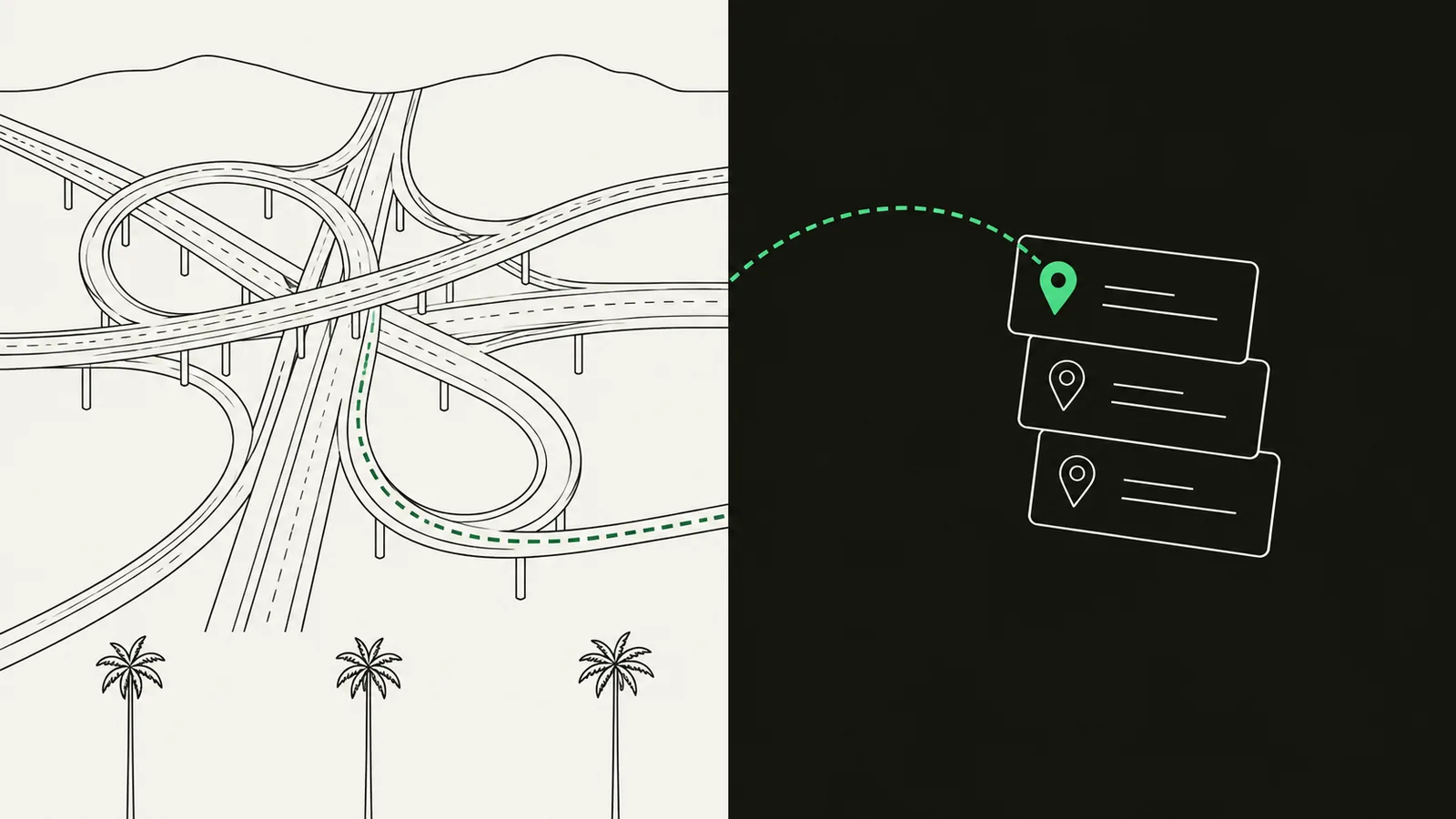
Type the same words in Santa Monica, Koreatown and Pasadena and Google hands you three different maps. Los Angeles isn't one market for the pack.
Google's own description of how the pack is drawn: "Distance refers to how far each business is from the customer who's searching. If a customer doesn't share where they are, Google uses what it knows about their location." The county has 88 incorporated cities, 14 of them over 100,000 people; the City of Los Angeles alone spreads 3,869,089 people over 470 square miles, 15 council districts and, by the Los Angeles Times' count, 114 neighborhoods — most of which never cross the 405 for a plumber. Nobody ranks "in Los Angeles." You rank where the phone is held.
ILLUSTRATIVE PACKS SHOWING HOW THE MAP IS REDRAWN BY THE SEARCHER'S LOCATION — NOT REAL BUSINESSES OR RATINGS. MILES ARE STRAIGHT-LINE FROM DOWNTOWN LOS ANGELES. WITHOUT A PAGE, A PROFILE AND REVIEWS THAT LIVE IN EACH OF THOSE PLACES, A BUSINESS IS IN ONE OF THE THREE MAPS AT BEST.
An LA driver lost 87 hours to traffic last year. A homeowner in Torrance will not book a company that's "only 17 miles away."
INRIX's 2025 scorecard: 87 hours lost per Los Angeles driver, fourth in the country and tenth in the world, at a cost of $1,602 each. TomTom's 2025 index calls Los Angeles "the most congested city in the U.S." — a 10-kilometer drive averages 15 minutes 30 seconds all day and 24 minutes 12 seconds in the evening rush, with the single worst corridor being the 101 southbound from Santa Monica Boulevard to Alvarado at 4 p.m.
What that does to search: a service radius in LA is a drive-time radius, and Google won't let you draw one anyway — "You can't set your service area as a radius distance around your business," only "up to 20 service areas" by city or ZIP. So coverage is built neighborhood by neighborhood, and each one needs its own page, its own proof and, where the customers speak it, its own language.
MILES: HAVERSINE FROM DOWNTOWN (34.0522, −118.2437). MINUTES ARE ILLUSTRATIVE — THE STRAIGHT-LINE DISTANCE TIMED AT TOMTOM'S 2025 ALL-DAY AND EVENING-RUSH PACE FOR LOS ANGELES; REAL ROUTES ARE LONGER. THE POINT IS THE SHAPE, NOT THE DECIMALS.
Three fights we pick.
Category and comparison pages that convert the demand your ads created — before a competitor's affiliate does.
“[brand] vs [rival]” · “best clean sunscreen”Post houses, stages, and rental gear found by producers who search by spec, format, and neighborhood.
“stage 4k led wall burbank”Law, medical, and home services where a single organic lead pays for the quarter — and the map pack is the whole game.
“spine surgeon santa monica”Rent vs. own.
Ads stop the second the card declines. Rankings keep answering the same queries — the spend becomes an asset instead of a bill.
More than half the county speaks something other than English at home. The Spanish search has its own pack, and almost nobody is in it.
The Census Bureau's 2024 American Community Survey for Los Angeles County: 55.2% of people five and older speak a language other than English at home — Spanish 37.6%, Chinese 4.1%, Tagalog 2.4%, Korean 1.6% — and 23.6% speak English less than "very well." The City of Los Angeles names its own Tier 1 languages: Spanish, Korean, Armenian, Chinese, Filipino/Tagalog and Farsi. A homeowner who types "plomero de emergencia" is served a Spanish results page, and Google says how it decides what belongs there: "Google uses the visible content of your page to determine its language."
So a second-language page is not a translated homepage. It is a real page at its own URL — Google: "Use different URLs for different language versions" and "Avoid automatically redirecting users from one language version of a site to a different language version" — written by a person for the neighborhood, with hreflang tags so each version lists the others. On this page, a language is a line item, not an add-on nobody scopes.
SAMPLE SNIPPETS SHOWING THE FORMAT — TWO PAGES, TWO URLS, EACH POINTING AT THE OTHER. GOOGLE: "EACH LANGUAGE VERSION MUST LIST ITSELF AS WELL AS ALL OTHER LANGUAGE VERSIONS."
The Opening Ceremony is July 14, 2028. In search terms that is about three cycles away — and the pages that will hold the Olympic packs have to be indexed this year.
Los Angeles welcomed 49.5 million visitors in 2025 — 43.1 million domestic, 6.4 million international, $42.6 billion in business sales, per the tourism board — and the eight World Cup matches at SoFi Stadium in June and July 2026 have already come and gone. LA28 says the Games run July 14–30, 2028, the Paralympics August 15–27, across "40+ competition venues" and no new permanent ones. Pages earn trust with age, so the calendar below runs backward from the torch.
The written audit: which neighborhood packs you're in, which languages your customers search in, what the site weighs.
Profiles cleaned and consolidated, service areas set by city and ZIP, the first neighborhood pages live and linked.
Second-language pages at their own URLs, review flow wired to the job, the first packs held through a full season.
Event, venue-adjacent and visitor pages published — a year of age before anyone searches them in earnest.
Visitor-season pages refreshed, hours and service areas reviewed, the change log quiet because the work is done.
Games and Paralympics. Pages that were built in 2026 are two years old, which is exactly what Google trusts.
Two levers set the fee: how many neighborhood clusters you can honestly hold, and how many languages your customers search in. Printed, month-to-month, no setup fee.
For scale: of the fifteen agency pages ranking for this search that could be read, four print a price — a national floor of "$500", "starting at $750/month", "starting at $2,500/m", and a $697 / $1,297 / $1,897 trio that never states the billing period. The Culver City agency that publishes averages lists "Neighborhood or Suburb Focused Local SEO" at $1,500 a month and "Metropolitan Area Focused" at $2,200. Ahrefs' study puts local SEO at $1,557 a month on average. Everyone else answers the cost question with a form.
A CLUSTER IS A NEIGHBORHOOD OR CITY WHERE YOU HAVE PROOF — JOBS, REVIEWS, PHOTOS — AND ONE REAL PROFILE PER STAFFED LOCATION. EVERY CELL: MONTH-TO-MONTH, CANCEL AT ANY MONTH'S END IN WRITING, NO SETUP FEE, A REPORT BY THE 5TH, ONE PERSON ON THE ACCOUNT, AND EVERYTHING BUILT — PAGES, PROFILES, CONTENT, THE CHANGE LOG — STAYS YOURS IN YOUR OWN ACCOUNTS. NOTHING HERE PROMISES A POSITION — GOOGLE'S OWN WORDS: "NO ONE CAN GUARANTEE A #1 RANKING ON GOOGLE" AND "THERE'S NO WAY TO REQUEST OR PAY FOR A BETTER LOCAL RANKING ON GOOGLE."
The questions Google shows under "Los Angeles SEO," answered with the numbers.
We're in Culver City but sell nationwide. Local or national SEO?
Both, split cleanly: national category pages carry the brand; LA pages carry the map pack and “near me” demand. They must not blur.
Our ads work. Why add SEO?
Because your ads are teaching Google's auction what your customer is worth — and your competitors' organic pages are collecting that demand for free.
Everyone here claims page one. Why believe you?
Don't. Take the free audit — it names the queries, the current holders, and the realistic timeline. Then decide with the numbers in hand.
How much does SEO cost in Los Angeles?
Here: $1,090 a month for one neighborhood cluster in one language, $1,690 for the bilingual block (three clusters, two languages), $2,390 for the county (up to twelve clusters, three languages), or a $2,600 one-time consolidation sprint — month-to-month, no setup fee, all printed in the matrix above. On this search only four of the fifteen readable agency pages print any number: "$500" as a national floor, "$750/month", "$2,500/m", and a $697 / $1,297 / $1,897 trio with no billing period. The Culver City agency that publishes averages lists neighborhood-focused local SEO at $1,500 a month and metro-wide at $2,200.
How much do SEO agencies charge?
Nationally, Clutch's September 2026 pricing guide puts the typical monthly retainer at "$2,000 - $20,000" and the average at $3,199; Ahrefs' poll of 439 SEOs found $2,917 a month on average, with 23% charging $500–$1,000 and local SEO at $1,557. Los Angeles runs higher for the hard verticals — on the Reddit thread Google shows for this search, the advice for a law firm was that "$3K/month is enough" is not, and to budget "$6k-$8k". For a neighborhood service business the fight is smaller and the matrix above is the honest size of it.
Which SEO company is the best in Los Angeles?
The one whose claims you can check. Three checks: search the street address on its profile — if the first results are virtual-office and coworking listings, that is where the "LA office" lives; ask for a Los Angeles client you can call; and see whether a price is printed anywhere. The Reddit thread Google surfaces for this search opens with "they all lied about their location and didn't see any rank improvements." This studio is in Austin, Texas, says so, and doesn't rent a Wilshire suite to sit in the pack — your map position is calculated from your address, categories and reviews, never from ours. Then look at the agency's own site: thirteen of the fifteen ranking pages run on WordPress page builders, weighing 83 KB to 1.2 MB with 10 to 127 scripts; this page is under 75 KB with four scripts and was written by hand.
What does an SEO company do?
On this page, six things you can see: a written audit of which packs and which language results you are in and out of; one clean profile per staffed location with service areas set the way Google allows; a page per neighborhood cluster with proof from that neighborhood; second-language pages at their own URLs, written, not machine-translated; the technical work — speed, Core Web Vitals, internal links, schema that matches the visible text; and a monthly report by the 5th with a change log of every edit made, so you can audit us the way we audited your competitors.
Is SEO dead now with AI?
No — the sources changed shape and the same work feeds both. BrightLocal's 2026 survey of 1,002 US consumers: 97% still read reviews for local businesses; Google's share as a review source slipped from 83% to 71%; use of "ChatGPT and other generative AI tools for local recommendations" rose from 6% to 45% in a year; and 42% "are unlikely to use a business that never replies." AI answers cite the same provable, neighborhood-specific pages and real reviews the pack does, so a business that is easy to verify wins in both places. A business that is not is invisible in both.
Is SEO still worth it in 2026?
Look at the top of this page: the clicks are $310, $38 and $11 apiece and they do not get cheaper. A ranked page stops the meter — the month-12 table shows what the same thousand clicks cost rented against owned. In a city where a single click can be priced the way the ones at the top of this page are, owning the organic and pack positions pays back faster than it would in a cheaper market. What has changed is the standard of proof: thin city pages stopped working; neighborhood-specific, reviewed, bilingual pages did not.
Do we really need Spanish pages?
If your customers search in Spanish, yes — 37.6% of the county speaks it at home and 42% of those speak English less than "very well" (Census, 2024 survey). The Spanish results page is a different pack with different, thinner competition; none of the fifteen ranking agency pages mention Spanish, Korean, Chinese or Armenian at all. What you don't need is a machine-translated copy of your site: Google reads the visible text to decide the language, wants each version at its own URL, and tells sites not to redirect people by guessed language. The pages are written, not run through a plugin.
How many neighborhoods can one company cover?
As many as it has proof for. Google allows "up to 20 service areas" per profile, set by city or ZIP, and one profile per staffed location. A shop in Culver City with real jobs in Santa Monica, Mar Vista and Playa gets those three pages first; a page for Long Beach, 20 miles and an hour away, would rank for nothing and convince no one. The audit maps where the trucks actually go before a single page is planned.
How long until we show in the pack?
Cleanup and the first pages take the first month; neighborhood pages usually earn positions in three to six months, faster in a second language and where the incumbents have thin reviews, slower on the Westside where they have thousands. Citywide legal and medical terms are a year-plus fight and priced accordingly. Nobody can promise a date — Google's own line is "No one can guarantee a #1 ranking on Google" — but the plan comes with month-by-month deliverables you can check against the change log.
Stop renting your traffic.
Free audit: what you're paying per click, and which of those clicks you could own.
Run my audit