Phoenix SEO for a metro that adds a suburb a year.
Home services, healthcare, and everything a quarter-million new residents need — searched suburb by suburb. The map pack is the battlefield, and coverage is the war.
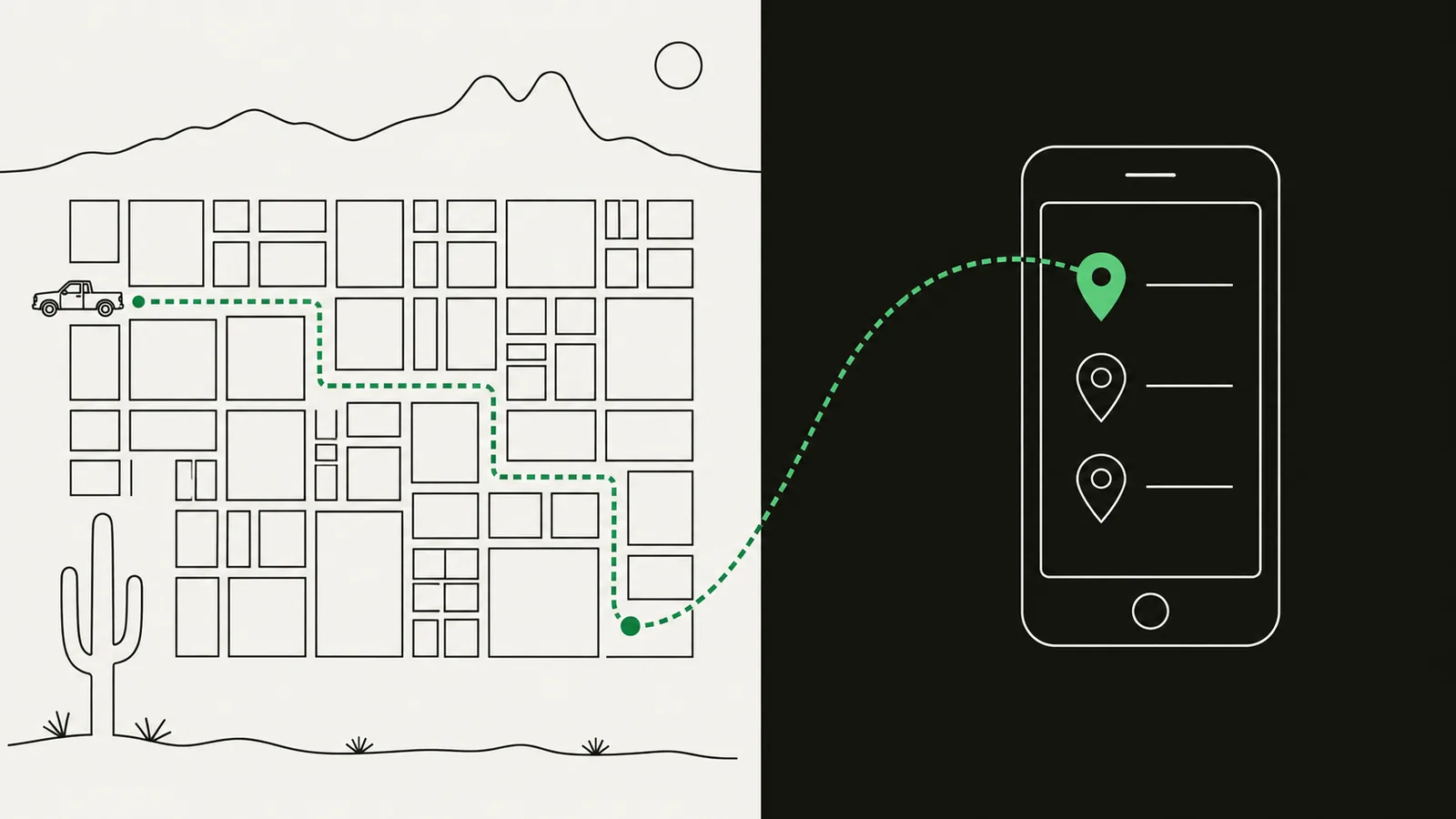
The map pack is drawn from where the searcher is standing. In a valley of twelve cities over 100,000 people, that is twelve different packs.
Google names three local ranking factors, and one of them is geography: "Distance refers to how far each business is from the customer who's searching. If a customer doesn't share where they are, Google uses what it knows about their location." A Business Profile parked downtown does not appear for a Gilbert homeowner 18 miles east, and a service-area business gets "up to 20 service areas based on the cities, postal codes, or other areas you serve" — by city, never a radius: "You can't set your service area as a radius distance around your business."
Maricopa County alone has 25 incorporated cities and towns, 141,071 private business establishments, and a metro of 5,228,938 people (Census, 2025). The ledger on the right is why "Phoenix SEO" is really a coverage decision: which of these packs you can honestly appear in, in what order. Valley buyers already think in those terms — an r/phoenix homeowner, on the AC company everyone recommended: "unfortunately they don't serve any address west of central."
Suburb-by-suburb buildout
Pages open in the order your trucks actually roll — driven by drive-time data, not wishful thinking.
Review velocity systems
The pack rewards fresh reviews per location. We wire the ask into your job-completion flow.
Summer-proof demand
AC failure queries spike at 115°F. Emergency pages rank year-round so July finds you first.
"For the second year in a row, Maricopa County, Ariz., gained more housing units than any other county: about 42,000." New rooftops have no search history — they have a pattern.
That sentence is the Census Bureau's, from its May 2026 release. The growth is at the edges: Queen Creek was the twelfth fastest-growing city in the United States last year at 8.2%, Surprise and Goodyear each added more than 7,600 people, and the four edge cities together outgrew Phoenix proper nine to one. A subdivision that closes this spring will search for an AC company by July, a plumber by the first freeze warning, a dentist and a pediatrician inside eighteen months. Nobody ranks for those searches yet, because the searchers didn't exist yet.
So pages open in an order, not all at once, and the order is written into the plan you get in 48 hours.
Cities where you have jobs, reviews and photos this quarter. Those pages carry proof on day one and rank first. Each ✓ on the map above is one of these.
Surprise, Goodyear, Queen Creek, Buckeye — the ○ cities. Pages open as the permits close, so the page is indexed before the first service call, not after the competitor's yard sign.
Every Valley city where the three businesses in the pack have under a hundred reviews between them. Google says prominence is "based on info like how many websites link to your business and how many reviews you have" — thin packs are the ones a real business can take in a season.
Twenty thin pages lose to eight real ones, and a profile at an address you don't staff is a suspension waiting for a quarter. The checklist below is Google's, not ours.
Seventy days at 110°F or hotter in 2024. The July page gets written in March, because Google needs the spring to trust it.
The National Weather Service counts at Sky Harbor: 55 days at or above 110°F in 2023, 70 in 2024 — the warmest year in the city's records — and 37 in 2025. In July 2023 Phoenix ran 31 consecutive days above 110°F, the hottest month on record for any U.S. city at a 102.8°F average. Demand for cooling, water, roofs and shade does not arrive on a schedule you can start ranking for in June. Google itself surfaces "Is Phoenix going to become unlivable?" as a question under this search, and the most-upvoted marketing thread on r/phoenix this year mocked an out-of-town campaign because "our street signs start literally melting and planes get grounded due to the heat."
The other season is the visitors. The 2025 Cactus League drew 1,695,480 fans to 221 spring-training games, $764 million in economic impact, and "about six in 10" of them from out of state, per the ASU study the league publishes. Winter pages get written in September.
Summer service pages published and linked: AC repair, emergency plumbing, roof and window heat, pool service. Three months of indexing before the first 110° day.
Winter-visitor and spring-training pages refreshed: the services a part-time resident buys in a hurry, the neighborhoods around the ballparks. Quiet again by May.
Half the Valley's packs are padded with offices nobody works from. Google's guidelines say what survives, and we build only inside them.
Every line on the right is from Google's "Guidelines for representing your business on Google," fetched in September 2026, and each ends with the same sentence: "Google reserves the right to suspend access to Business Profiles on Google or other Google Services to individuals or businesses that violate these guidelines." When a competitor's six fake suites vanish in a purge, the real profiles underneath inherit the pack. That is the whole strategy — and the reason the map at the top of this page only shows ✓ where trucks actually roll.
The wider picture, from BrightLocal's 2026 national survey: "just 35% of SMBs have a Google Business Profile" at all. Most of your competitors are not in the pack because they never claimed it — which is the easiest gap in local search.
"If your business rents a physical mailing address but doesn't operate out of that location, also known as a virtual office, that location isn't eligible for a Business Profile."
One profile per location your own staff works from. No suite numbers bought for the pack.
"Businesses can't list an office at a co-working space unless that office maintains clear signage, receives customers at the location during business hours, and is staffed during business hours by your business staff."
If it isn't signed, staffed and open, it isn't a location — it's a service area, and it gets a page instead.
"P.O. boxes or mailboxes located at remote locations aren't acceptable."
Nothing on the profile that a homeowner couldn't drive to and find you at.
"Do not create more than one page for each location of your business, either in a single account or multiple accounts."
Duplicates merged before anything else — they split your reviews and your prominence in half.
"If you're a service-area business, you should hide your business address from customers." "For example, if you're a plumber and run your business from your residential address, clear the address from your Business Profile."
Address hidden, service areas set by city — up to Google's twenty — and the coverage carried by pages, not pins.
"You can't set your service area as a radius distance around your business." Boundaries "shouldn't extend farther than about 2 hours of driving time from where your business is based."
Twenty named cities and ZIPs that match where the trucks go, reviewed each quarter as the rooftops move.
The fee follows the number of Valley cities you can honestly rank in — printed, month-to-month, no setup fee.
For scale: Ahrefs' pricing study puts local SEO at $1,557 a month on average; Clutch's September 2026 guide puts retainers at "$2,000 - $20,000" a month; a Scottsdale agency that prints its numbers says "Local SEO in Phoenix typically runs $800 to $2,500 per month." Of the six agency pages on page one of this search, none prints its own price; a Phoenix listicle on the same page says it outright: "not one publishes a rate." The national agency's form starts its budget dropdown at "$2,500-$5,000 per month." Ours are below, with the deliverables in the same row, so you can hold us to them.
EVERY PLAN: MONTH-TO-MONTH, CANCEL AT ANY MONTH'S END IN WRITING, NO SETUP FEE, A REPORT BY THE 5TH, ONE PERSON ON THE ACCOUNT. NOTHING ON THIS PAGE PROMISES A POSITION — GOOGLE'S OWN WORDS: "NO ONE CAN GUARANTEE A #1 RANKING ON GOOGLE," AND "THERE'S NO WAY TO REQUEST OR PAY FOR A BETTER LOCAL RANKING ON GOOGLE." WHAT WE PROMISE IS THE WORK, DATED, AND THE PLAN IN 48 HOURS.
New subdivisions have no search history. How do you target them?
By pattern — every new rooftop searches the same services within 18 months. We open pages as the permits close.
Competitors use fake offices to fill the pack. Should we?
No — suspensions wipe those out every quarter. Real presence, built right, survives the purges and inherits their spots.
Snowbirds double our winter market. Can pages be seasonal?
Yes — winter-visitor services get their own pages, refreshed each fall, quiet all summer. The calendar is part of the architecture.
We cover the whole Valley. One page or twenty?
Twenty thin pages lose to eight real ones. We build only where you have proof — reviews, jobs, photos — and expand as it accrues.
How much does an SEO service cost in Phoenix?
Here: $890 a month for one city, $1,390 for a corridor of up to five, $1,990 for the whole Valley, or a $2,400 one-time purge-proofing sprint — all month-to-month, no setup fee, printed above with the deliverables. For scale, Ahrefs' study puts local SEO at $1,557 a month on average and Clutch's September 2026 guide puts agency retainers at "$2,000 - $20,000" a month; the Scottsdale agencies that print prices start between $800 and $1,500.
How many Google Business Profiles can we have across the Valley?
One per location your own staff works from, plus "up to 20 service areas" on each, set by city or ZIP — Google's rules, quoted in the checklist above. A profile at a rented suite or a co-working desk isn't eligible and gets purged. Coverage beyond your real locations comes from pages, reviews and links, which is what the plans above ship every month.
How long until we show in the pack?
Cleanup and the first pages take the first month. New pages usually earn their pack positions in three to six months, faster in the thin edge-city packs and slower in Scottsdale and Chandler where the incumbents have thousands of reviews. Nobody can promise a date, and Google says so itself: "No one can guarantee a #1 ranking on Google."
Is SEO dead now with AI?
No — the reader changed, the work didn't. Yes, people still find local businesses on Google, and increasingly through AI too. BrightLocal's 2026 national survey: 97% of consumers read reviews for local businesses, Google is still where most read them (71%, down from 83%), and 45% now use ChatGPT or similar tools for local recommendations, up from 6% a year earlier. The same provable pages and real reviews get cited by both — there is no separate "AI package" on this page.
Is SEO still worth it in 2026?
For a Valley business with a real location or service area, a season to plan for, and three to six months of patience — yes, because the packs are drawn city by city and most of your competitors never claimed theirs. It is the wrong tool if you need calls this week (that is Google Ads, run at a flat fee), if your profile isn't eligible under the checklist above, or if the budget can't survive two quiet months. The written audit says which of those you are before you pay for anything.
What is the best SEO company in Phoenix, Arizona?
Ask three questions of any page that ranks for that search: is the address one their own staff works from, is the price printed, and does the form demand your phone number. On this search, none of the six page-one agency pages prints a price, five of six require your phone, and none quotes Google's own local-ranking guidance. A business owner on r/phoenix put the brief in one line: a local service "that does everything in house — not interested in paying for a middleman." That is what this page is: one developer, printed prices, Google's rules quoted, no rep in between.
What does an SEO company actually do each month?
Here it is a fixed list you can check: the Business Profiles worked weekly (posts, photos, Q&A, review requests wired to the job), two to five new city or service pages shipped in the rooftop order, negatives found in your search terms if ads run alongside, the technical fixes committed to the site itself, and a report by the 5th that names every change. Nothing is written by a machine and pasted — a Phoenix realtor's assistant on r/PHXList this spring: "it's very obvious all of the companies I'm finding write their blog content using AI, which is exactly what we don't want."
Map your coverage gaps.
Free audit: your pack presence suburb by suburb, and where the next rooftops are going in.
Run my audit