Google Ads management at a flat fee that doesn't grow with your budget — from $490 a month, in an account you own.
A Google Ads agency of one, for US companies that are tired of paying a percentage of their own ad spend to the people spending it. Search, Shopping, Performance Max and Local Services campaigns built and run in your Google Ads account, on a fee printed here — $490, $1,190 or $1,990 a month by spend band — with $0 setup, no minimum ad spend, and cancellation on one business day's notice. It starts with a $0 audit of your search terms, written, in 48 hours, without a phone call.
Ask any Google Ads agency one question before you sign: does your fee go up when my spend goes up?
Most answer yes, in their own words. WebFX: management fees are "Typically 10% – 20% of your ad spend or around $1,000 to $3,000 per month." LYFE Marketing's chart: "12% to 30% of ad spend per month." HawkSEM: "generally somewhere between 10% - 30%." Solutions 8: "Other premier agencies charge 35% of ad spend and more." Google's own AI Overview on this search says it plainly: "Most agencies charge 15% to 20% of your total monthly ad budget." A percentage fee pays the agency more every time it raises your budget. One r/smallbusiness answer this September put the rest: "avoid anyone charging a % of ad spend since they literally profit more the more you waste." Ours doesn't move.
15% AND 25% ARE ILLUSTRATIONS INSIDE THE RANGES THE AGENCIES ABOVE PRINT THEMSELVES. THE CROSSOVER IS ABOUT $3,300 A MONTH IN SPEND: BELOW IT, A 15% FEE COSTS LESS THAN OUR FIRST BAND, AND THE WRITTEN AUDIT WILL TELL YOU THAT INSTEAD OF SELLING YOU. ABOVE IT, THE GAP ONLY GROWS.
Three bands on one ruler. The band is set by what you spend with Google, and the fee inside it never changes.
Campaign build or rebuild in your account · the day-one settings pass below · conversion tracking wired through Google Tag Manager (free, per Google) into Google Ads and a Looker Studio report (its self-service tier "remains available at no cost") · search terms reviewed and negatives added every week · one landing page tune-up a month, or a build on our landing page desk if there's nothing worth sending clicks to · a weekly change log in your inbox · a report by the 5th · one person on the account, the one who answers the audit.
$0 setup — the rebuild is month one's work, not a line item. The agencies that print a price on this search all add one: Third Marble a "$399 onboarding fee," Pronto "$500 FOR SETUP," WebFX a "$1,200" first month, LYFE Marketing an "Account Setup Fee: $300 (Call us to waive)." No minimum ad spend from us, because Google has none either: "There's no minimum ad spend, and you can set a daily or monthly cap that works for your business." Ad spend is paid by you, to Google, on your card, at cost. No contract: cancel with one business day's written notice, and the month you're in is the last one billed — against WebFX's "minimum contract length… six months" and Logical Position's 6-, 12- and 18-month terms. Move up or down a band as your spend moves; the fee follows the band, never the other way around.
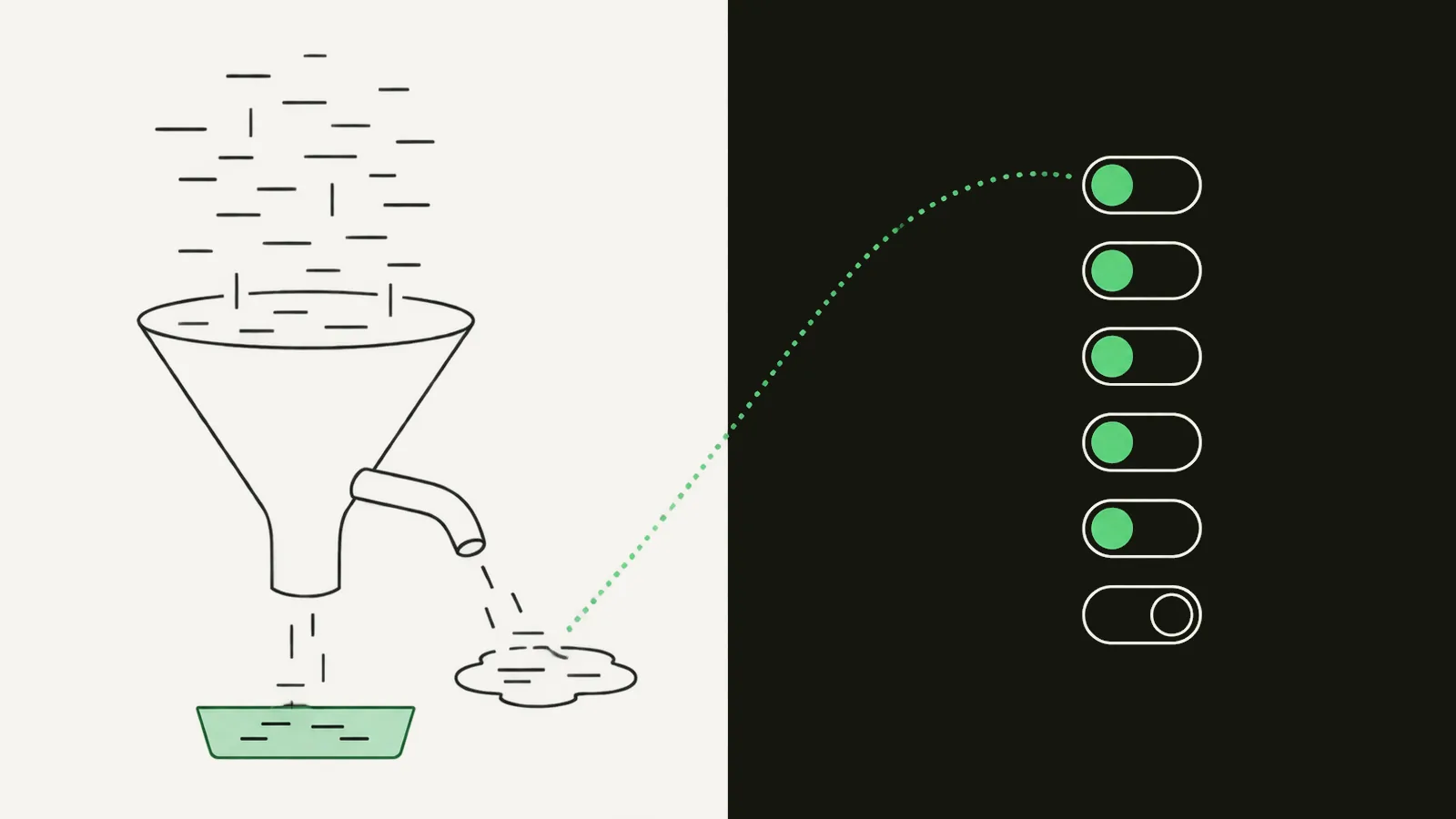
Six switches Google ships in the position that spends more. We flip them the first morning, and the change log shows you which.
Every quote on the right is from a Google Ads help page, fetched in September 2026. None of these defaults is a scandal — Google says most of them out loud. They are simply set for reach, and you are paying for precision.
The one we leave alone: Google's "Automatically apply recommendations" is opt-in and, in Google's words, "can be turned on or off at any time." We read every recommendation and apply the ones that serve your goal, by hand, with our name on the change.
Google: "When you create a campaign for the Search Network, search partners are included by default." And: "Google Ads doesn't provide information detailing the website where your ad was shown on the Search Network, unless you are running a Performance Max campaign." Clicks you can't see the source of come off until the data says otherwise.
Google: "Broad match is the default match type that all your keywords are assigned because it is the most comprehensive." Comprehensive is how "cleaning services" buys the search "how to start a cleaning business." Phrase match, exact match where the money is, and a negative list that grows every week.
Google: "By default, location targeting includes both physical locations and locations of interest." The default option "lets you reach people who are likely to be in or regularly present in your targeted location, as well as people who have shown interest in your targeted locations." A company that serves Austin doesn't need clicks from someone in Ohio reading about Austin.
A checkbox in the Network settings of a Search campaign. Google's own note: "If you've been running Search Network campaigns and then expanding to Display, you may notice an increase in conversions and thus, an increase in daily spend." Search budget stays on search until Display earns its own budget.
Google: "Optimization score is an estimate of how well your Google Ads account is set to perform." It is an estimate, and it moves when you accept suggestions that usually add reach or budget. Google's own Partner program requires only a 70% score, and its FAQ says partners are "not required to … achieve a 100% optimization score." Neither are you.
Google: "a goal-based campaign type that allows you to access all Google Ads inventory, including YouTube, Display, Search, Discover, Gmail, and Maps, from a single campaign." Powerful with real conversion data and brand exclusions; a blender without them. It gets a budget once Search has proved what a lead is worth, not on day one.
Google already keeps the receipts. We work where you can read them.
Google's Change history "lists the changes made to your account, campaigns, and ad groups during the past 2 years," with a column for the user who made each one. Because the work happens inside your account, every bid, negative, and budget move carries our email in that column — and every Friday the same list arrives in your inbox in plain English, with the reason next to each line.
Google's own caveat on that page: "Sometimes, not all account-level settings changes or changes made by Google representatives during consultations are listed." Which is why nobody but you and us holds standard access, and why the free Google Ads Expert calls — "We'll design a media plan, select the right keywords, and optimize your budget," in Google's words — go to us, not to your account. The top-voted answer on r/PPC this month, on those calls: "Google reps have never run ads themselves. They are sales people that ask you 'to increase budget' to hit their KPI." And on agencies, from a business owner paying $1,000 a month: "I check the change history all the time they do very little in the account." The log is how you never have to check.
Added 14 negatives from the search terms report — "jobs," "salary," "training," "diy" and eleven more. Why: $173 spent on them in two weeks, zero leads.
Moved "commercial cleaning services" from broad to phrase match; split "office cleaning" into its own ad group with its own landing page. Why: two intents were sharing one ad and one page.
Dismissed Google's recommendation to raise the daily budget 40%. Why: cost per lead is $61 against a $90 target, but the extra budget would go to the 8 p.m. – 6 a.m. hours, where nobody answers the phone.
Ad schedule: bids -40% overnight, +15% weekdays 8–11 a.m. Why: 71% of leads booked from morning clicks in the first three weeks.
No changes. Why: nothing had enough data to justify one. A change log that says "nothing" is a change log you can trust.
We are linked to your account, not the owner of it. Google's own access levels say who can throw us out.
Agencies that run your ads inside their own account keep the history, the conversion data, and the leverage when you leave. Here the account, the billing, and the two years of change history are yours from the first day; we work through a manager-account link, and Google's help page spells out the balance of power: "users with administrative access to those accounts can terminate the relationship with the manager account at any time by unlinking their account." Also Google's: with a manager account, "you won't be able to change proprietary information for a client account, such as the account's sign-in information." The reason it matters, from r/PPC: "Many will also try to sell you on new builds with development fees in a new MCC that you will not be the owner of."
Across 23 industries, a Google Ads lead cost $66.69 in 2026. Whether that's cheap depends entirely on what a customer is worth to you — so the audit does that arithmetic before anyone spends a dollar. An r/smallbusiness owner's advice for choosing an agency: "ask them what they'd tell you NOT to do."
LocaliQ's 2026 study of 13,000+ campaigns: $5.42 per click, 6.64% click-through, 8.18% conversion, $66.69 per lead across industries. Furniture pays $106.70 a lead and Real Estate $102.51; Auto Repair pays $29.96 and Arts & Entertainment $26.84. Your industry sits somewhere on that line, and we'll show you where.
Take what a new customer is worth in gross profit, multiply by the share of leads your team actually closes, and that is the most a lead may cost. If your industry's benchmark cost per lead is more than a third of that number, ads are a knife fight, and the audit will say so before you fund it.
Nowhere to land the click — a homepage is not a landing page, and we'd build one first. No way to measure — no conversion tracking, no call tracking, no CRM to see what a lead became. Nobody to answer — a form that waits until Monday turns a $66 lead into a $66 receipt. Fix those, and the account earns its budget.
The Google Ads management questions under the search box, answered with the numbers on this page.
01.How much should I pay someone to manage my Google Ads?
Here: a flat $490, $1,190 or $1,990 a month by spend band, $0 setup, no minimum ad spend, cancel on one business day's notice. What the ranking pages print: Third Marble "starts at $499 per month" plus a "$399 onboarding fee" and "$1000/month per campaign" minimum; Pronto "$500 /mo + $500 FOR SETUP" and "10% of your ad budget" above $5,000; WebFX "Starting at $750 per month" (its FAQ says $650) with "$975 or 15% of spend, whichever is higher" above $5,000 and a six-month minimum; Logical Position a rate card that turns into 10–12% of spend above $5,000. Google's AI Overview sums the rest up: "Most agencies charge 15% to 20% of your total monthly ad budget." Ad spend is separate on every model and goes to Google.
02.Is $500 a month enough for Google Ads?
Enough to learn, not enough to live on. At the 2026 cross-industry averages — $5.42 a click and an 8.18% conversion rate — $500 buys about 92 clicks and 7 leads, which tells you whether your offer converts and what a lead costs in your market. Google itself has no floor: "There's no minimum ad spend, and you can set a daily or monthly cap that works for your business." An r/adwords owner's warning is fair, though: "Below $1,000-1,200/month you're often just funding Google's education on your account." Under about $3,300 a month in spend a percentage-fee agency is cheaper than our first band, and the written audit will say so instead of selling you.
03.What does a Google Ads agency actually do every week?
The honest answer is "less than you think" at most shops, which is why a business owner paying $1,000 a month wrote "I check the change history all the time they do very little in the account," and why his conversion tracking "stopped working for three weeks and no one noticed." Here the week is fixed: the search terms report read and negatives added, bids and schedules adjusted against the target cost per lead, Google's recommendations reviewed by hand, tracking checked, one landing-page improvement, and a Friday change log that names every change and its reason — with a "no changes" week reported as exactly that.
04.Is it worth paying someone to manage Google Ads?
Only if the fee is smaller than the waste it removes. WordStream's June 2026 study of 15,000+ accounts found "the average business wastes $1,127.54 in Google Ads per month," and that accounts with at least one negative keyword convert at 13% against 4.6% for accounts with none. That is the whole case for management, and also the test: the $0 audit shows what your account is wasting before you decide whether $490 a month to stop it is worth it.
05.Who owns the Google Ads account, and what happens if I leave?
You do, from the first day: the account, the billing, the conversion data, and the change history stay under your Admin access. We work through a manager-account link that Google lets you unlink at any time, and the audit runs on Read-only access you can revoke the minute the report lands. Google bills your card directly. Leaving is one business day's written notice; nothing has to be handed back, because nothing left your account. The r/PPC rule is the same one: "whoever you go with make sure YOU own the account."
06.Do you run Local Services Ads and Performance Max too?
Yes, both, inside the same fee. Local Services Ads are moving into Performance Max campaigns with pay-per-lead goals — Google's first phase began in August 2026 for US home-service advertisers, "manual bidding (such as setting a maximum cost-per-lead) is no longer supported," and "you still only pay for valid leads." Standard Performance Max gets a budget once Search has shown what a lead is worth. Roofers and plumbers should look at the lead pages instead, where ad management is bundled with the rest of the phone: roofing and plumbing.
07.Are you a Google Partner?
The badge measures the agency, not your account. Google's requirements: a manager account with "a minimum optimization score of 70%," a "90-day ad spend of $10,000 USD across managed accounts," and "a minimum of 50% of your account strategists certified." Premier is "the top 3% of participating companies within a given country," judged on client growth and annual ad spend — which is why four agencies on this search call themselves the top 3% and a fifth the top 1%. None of it is a promise about your cost per lead, so this page prints defaults, fees and a change log instead of a badge.